See talk-time by gender
RoomRadar can show how speaking time splits by gender, measured per person, so it reflects whether each voice got comparable airtime rather than just the raw split.
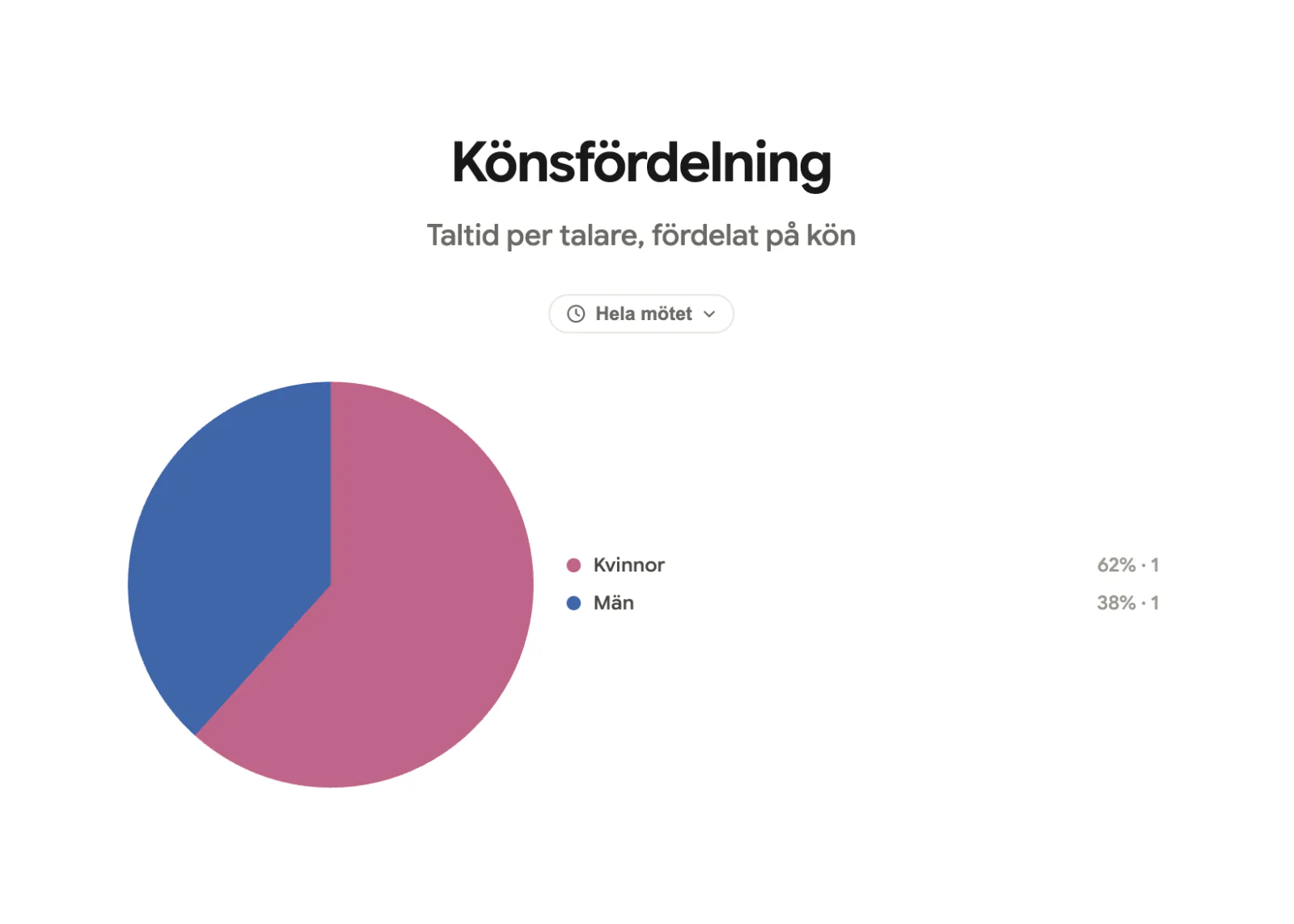
Who actually got heard? RoomRadar can answer that with a gender balance view: it shows how speaking time splits between women and men, across a group or the whole room. It is measured per person, normalised to how many people of each gender were present, so a table with one woman and five men is not automatically counted as male-dominated. What you see is whether each person got comparable airtime.
Turn on the speaker-data model
The gender view needs the speaker-data model (talardata), the model that separates who is speaking so talk-time can be counted per person. Choose it under Settings → Transkribering & AI before the workshop. Without it there is no per-speaker data to break down by gender, so the chart does not show, and Kön in the overview's Vy menu is greyed out. Hover it and it tells you which setting to change.
Read the chart
Open the overview and find the Könsfördelning (gender balance) card. It shows the split as a share per person, for example 62% · 1 women and 38% · 1 men, where the number is how many people of that gender were counted. Use the time-range menu to look at the whole meeting or a slice of it, and the open-in-window button to pop the chart out on its own, handy for showing the room on a screen, or keeping it up while you facilitate.
Set the gender yourself
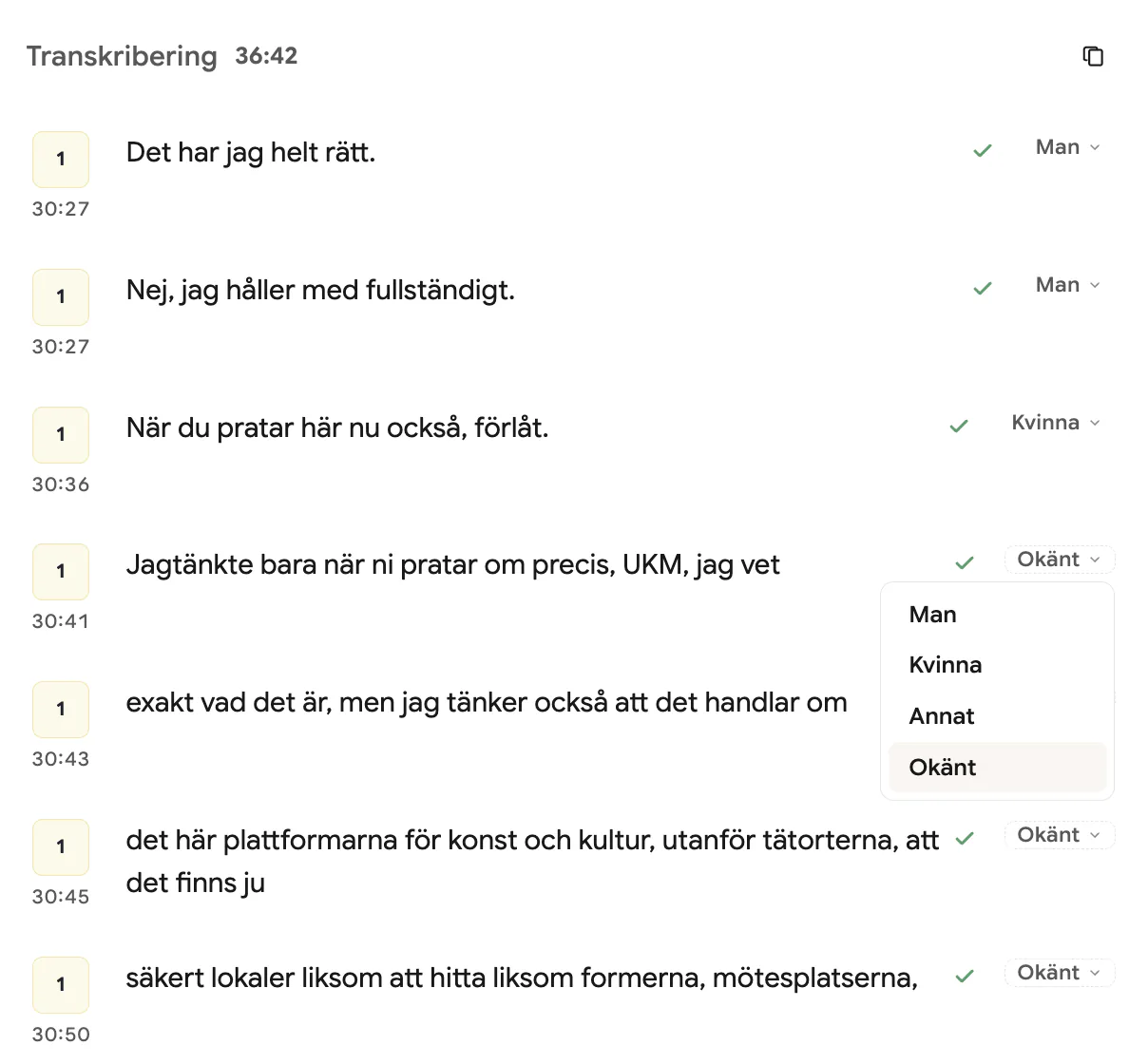
Gender is not detected automatically, you set it by hand. In the transcript, open the label on a line and choose Man, Kvinna (woman), Annat (other), or Okänt (unknown). Lines stay Okänt until you assign them, and every label you set feeds straight into the chart, so tag a few lines for each speaker and the balance fills in.
FAQ
It only appears when the speaker-data (talardata) transcription model is on. Choose it in Settings before the session, the plain model does not separate speakers, so there is nothing to break down by gender. When it is off, Kön is still listed in the overview's Vy menu but greyed out, and hovering it says where to change the setting.
On talk-time, measured per person. It normalises for how many people of each gender were present, so it reflects airtime per speaker rather than a raw head-count.
No, you assign it yourself on the transcript lines, Man, Kvinna, Annat, or Okänt. The chart is built from the labels you set, and updates as you set them.